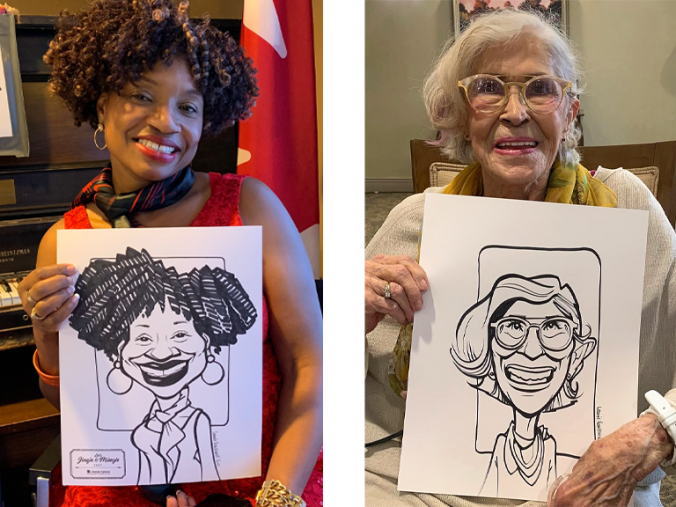
I recently had the opportunity to chat with Edmonton-based caricature artist Laurel Hawkswell… and her pup, Cooper.
Cooper didn’t have a lot to share beyond a couple of barks here and there, but Laurel has such an optimistic outlook on life that we had a lot of laughs and positive vibes going that made up for Cooper’s less-than-engaging style.
Enjoy our conversation below and make sure you check out her Daily Doodle over on Instagram. She tells me she will be doing them until at least the end of the year.
[Featured Artwork: Caricatures by Laurel Hawkswell.]
“I booked my annual touch up,” she said, legs tucked underneath her on the blue easy chair in the corner of our living room with a small bowl of potato chips in her lap and phone in hand.
“Touch up?” I queried, mindlessly thumbing through my Facebook feed on my iPhone.
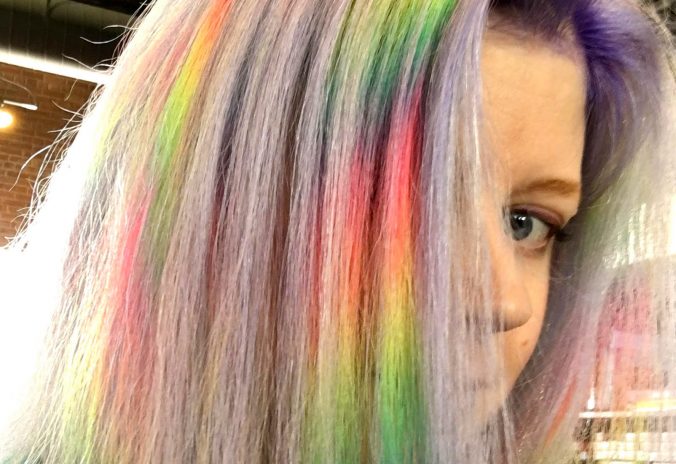
“Yeah, remember unicorn farts?” she said, referencing a previous Saturday Morning Story where I, ahem, rather uniquely described her trademark hair color.
“Nope,” I said without breaking my thumb’s mesmerizing swiping motion.
I had a super-positive conversation with Alberta-based artist Samantha Williams-Chapelsky. Many of you are likely already familiar with her, especially if you follow her prolific Instagram account, but this was the first time she and I had ever chatted.
I enjoyed so much our discussion around the business of art. She’s been incredibly successful at cracking that egg. Of course, there’s always more to be done and I look forward to following her career as she continues to do it.
Enjoy this week’s artist spotlight below and be sure to check out Sam on Instagram.
[Featured Artwork: “Polka Dot Water” by Samantha Williams-Chapelsky. Acrylic on birch panel.]
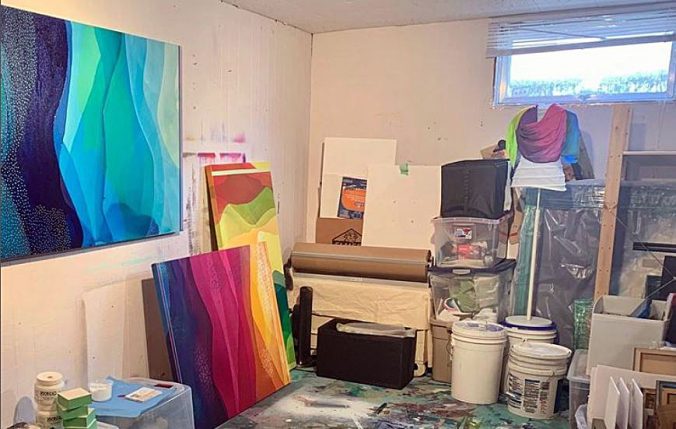
My artist wife spent 10 years without cleaning her art studio in our suburban, prairie bungalow. Her studio, the size of a living room, fills a quarter of our basement.
Paint-covered floors, canvasses stacked everywhere, and piles of paint supplies in the middle of the room were common behind the perpetually closed door. As sure as the sun rises, that studio would be a mess.
Yet, it took her the time of one my strength-training workouts to clean the place.
I chatted with Miles Constable recently. It was a great conversation filled with a lot of laughs. He is a retired Environment Toxicologist who always had artistic tendencies but didn’t fully lean into them until after he retired. Now, he’s been successful at making a go of being a professional artist; although, he would tell you he’s not quite there yet.
Our conversation, which you can read below, took many interesting turns but what really comes out — aside from his love of the great Miles Davis — is his passion to explore mixed mediums and how they interact and react to each other.
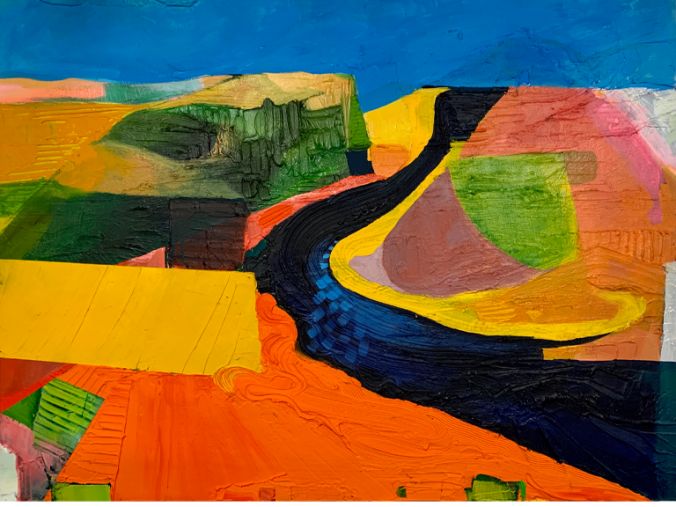
[Featured Artwork: “Summerfallow” by Miles Constable. Acrylic and copper on reversed birch panel.]
The following responses are lightly edited for length and clarity.
01. Rock, paper, or scissors?
I mix it up. Like they say in the army, max flex. You gotta keep it moving.
02. What is the main medium you use in your art pieces?
It varies. Ultimately, I like working in acrylics, currently on reversed birch panels in a reverse birch panel, abstract, mixed medium approach.
03. The featured piece at the top of this post is Summerfallow. What inspired it?
Summerfallow is a follow-on from a painting I did eight years ago with the same sort of feel to it. It is a a fairly abstract field with a very thin line of trees and a nightfall in the background. I grew up on the Prairies and you see a lot of that — tree lines in the distance. I wanted to recreate that using new materials.
I’ve been working with copper and used birch panels recently and you get a lot of interesting reflections depending on whether you use glossy or matte paint. And, you get variations in the copper depending on how much you heat it with a butane torch. You can get everything from a reddish orange to a deep matte purple. I used that copper as the distant tree line.
In fact, the painting will be part of a show at VASA (Visual Arts Studio Association of St. Albert) I have with artists Janet Sutanto and Cathy Bible in June.
04. What inspires your art?
A lot of my art comes from inside my head; like the Summerfallow scene. I’ve seen a lot of that sort of scenery in Saskatchewan and Alberta. It takes a long time to, sort of, percolate through my brain and come out. A lot of times it occurs to me while I’m painting that I can put some rough yellow stuff in here that looks like canola and a dark green over there to make it look like a tree line. It starts to evolve in a sort of unconscious way.
05. What is your go-to band or artist?
Miles Davis. I have most of his discography. He’s just wildly inventive. You listen to a lot of the work he did in the ’50s and ’60s and you go, “Ho hum, that’s just straight-ahead jazz.” But it wasn’t in the 50s and 60s, he was inventing it.
06. Are you more productive at night or in the morning?
Typically, morning into afternoon. All of my art is done in my studio, which is located at VASA. I had this series of fast developing paintings, called Miles on Miles, where I put on Miles Davis’ CDs, had too much coffee, and was bouncing around the studio and squirting paint onto the canvas. I couldn’t have drank that much coffee at night.
07. What movie title best describes your life?
“Family Man.” (Miles has two grown daughters and, in fact, we had our chat while he was visiting them in Ontario.)
08. Is art your career or a hobby?
It started out very much as a hobby. After 4-5 years of renting a studio, I decided I might as well get a business license and try to do it as a business. If, for no other reason, than you get tax benefits. I recommend every professional artist take an income-tax course for artists. It will teach you how the government treats artists and how to maximize your business.
09. Where did your passion for art start?
As a kid. My brother and I were forever coloring on the wide pieces of printer paper. My father worked for IBM so he brought home lots of it. But growing up in the ’60s & ’70s, every classroom had artwork from the Group of 7. It was kind of like being surrounded, at that time, by the best of Canadian art.
In 2004, I took lessons in a very realistic style. After that, I wasn’t really excited about the realistic part of painting so I started experimenting with how little you can put on a canvas and still have it look like a landscape. It came down to: If you put a line across it, it can still look like a landscape. There’s always a horizon line. You can put almost anything on the painting if there’s a horizontal line.
10. What is the best single day on the calendar?
I’m retired so every day is Saturday but I don’t get any holidays.
11. If money wasn’t an issue and you didn’t have art, what hobby would you get into?
I don’t know because money is always an issue. I would probably buy something more than a $40 guitar.
12. What do you hope people get out of your art?
Enjoyment. Something that tickles their imagination.
The six most feared words in my world are: “I’m going to the paint store.”
If my artist wife and I have been together for two decades, the paint store has been a fixture in our relationship for just as long. And it stubbornly sat there between us for 15 years.
Every so often, she would take her one-hour round trip and come home with a car full of supplies. When she got home, I would ask the question I didn’t really want to know the answer to: “How much did you spend?”
Inevitably, my response to the dollar amount was, shall we put it mildly, incredulous.